Developed by Professionals for Professionals
Leave your contacts and our Team will reach you back to discuss the terms of cooperation

TYPES OF DEVICES

e-cIGARETTES
VAPORIZERS

HTP

eNDS
List of Tests

Puff count test
pRESSURE DROP TEST
VAPOR DENSITY
EVAPORATION MASS DURING A PUFF (EMP)
VAPOR EMISSIONS COLLECTION
DEVICE LIFECYCLE
Puff Count Test
The aim of this test is to count the maximum number of puffs from one cartridge, pod, or device.
The test shows the real number of puffs a device can provide with a fully charged battery. The collected information allows to compare the real amount of puffs with that claimed by the manufacturer. According to the test results, you can estimate the amount of substance remaining in the cartridge after the battery is discharged (if it remains), or you can evaluate the balance between the battery capacity and the consumption of the substance.
The test is performed according to the international recommended standards and methodology.
The device to be tested is connected to the machine and works until the battery is discharged, or the liquid runs out, and it’s detected automatically by a special HAVC sensor.
Test results are stored in a raw format in the WEB interface of HAVC and can be downloaded in the form of xls and pdf reports with graphs.
Pressure Drop Test
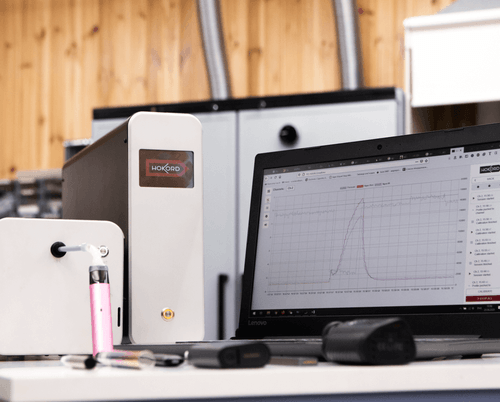
Another test that can be performed using HAVC is the pressure drop test.
The test shows the tightening force that must be applied to activate the device, as well as the pressure drop that is created in the air channels. The information can be used when comparing different devices and evaluating the design features of air channels.
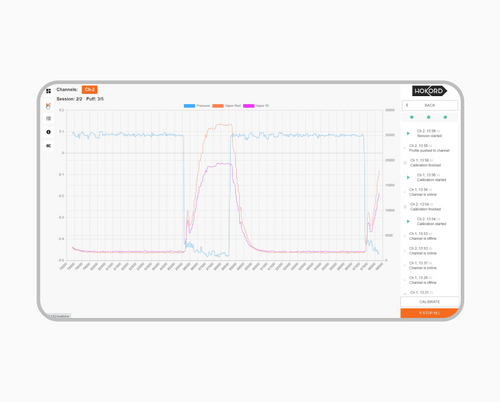
The deviation of the pressure drop between the test sessions is measured and the data can be generated in the form of a diagram. The pressure drop is measured in Kpa.
Vapor Density Test
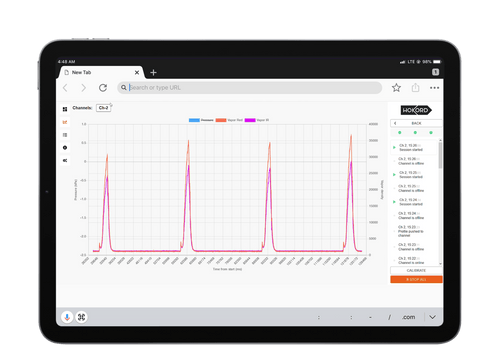
This test shows visual and numeric difference in vapor density which is measured by HAVC’s special built-in sensor. This test determines how much vapor а device generates during puffing.
Based on the test results, it is possible to make a conclusion about the quality of technical solutions used in the device’s airflow design, as well as obtain information about vapor volume released during a single or a series of puffs, observe qualitative changes in the tightening force and the amount of vapor during the long-term operation of the device or during declared sessions.
A decreasing trend of vapor density with noticeable ups and downs signifies the unstable operation of the device’s internal electronic components and require further device improvement and adjustment. The test is useful both when comparing the performance of several devices of the same type, and when examining a single device.
The vapor density value deviation throughout the whole period of puff sessions can be generated in the form of a diagram.
Evaporated Mass During a Puff (EMP) Test
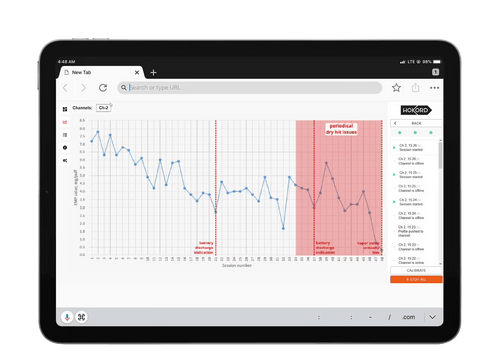
The EMP value gives an idea of how much substance is evaporated during one standard puff.
This value should be stable from the beginning and until the end of the test. The decreasing trend with noticeable ups and downs indicates unstable operation of the device.In most cases, the EMP depends on the battery voltage and can decrease when battery discharges and there is no effective algorithm for the internal electronics. Thus the output voltage level correction is required. The non-stable work of the heating element’s feeding by e-liquid inside the device can also produce unacceptable EMP ups and downs.
The average EMP value is calculated from all performed test sessions (e.g. 1 session – 10 puffs) and is measured in mg/puff.The EMP value deviation throughout the whole testing period can be generated in the form of a diagram.
Vapor Emission Collection
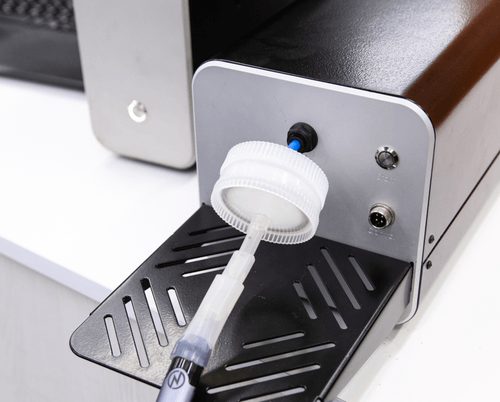
With the help of HAVC you can collect vapor emissions for chemical analysis. Before vapor emissions collection, it is required to run precise calibration of HAVC with the help of a certified Bubble Flow meter.
The vapor is collected in special filters. After calibration is complete, you can connect filter pads and devices to HAVC to conduct a puff session according to the recommended testing methodology.
All vapor is deposited on the filter. After collecting the samples, the filter is weighed and packed in an air-tight container. It can then be sent for chromatographic analysis.
Device Lifecycle
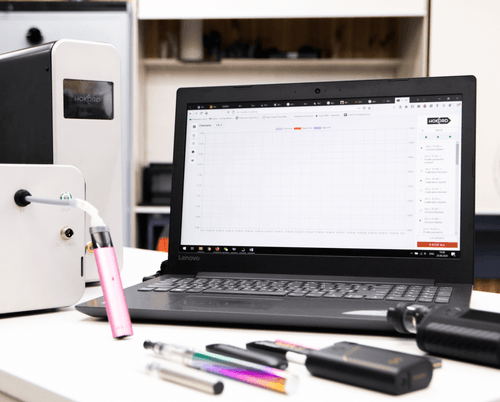
This test is aimed at studying the life cycle of a device.
The device is connected to the machine and works until the battery is discharged or the liquid runs out, which is automatically detected by a special built-in sensor.
By the end of the test, you will see all critical parameters tested throughout the device’s lifecycle, such as: EMP, pressure drop, number of puffs, and vapor density.
The information collected during this test is used in conclusions about the balance level of the device, the stability of the device’s performance throughout its lifecycle, and is used as part of recommendations for improving the characteristics of the device.
Additional Features
HAVC WEB Interface
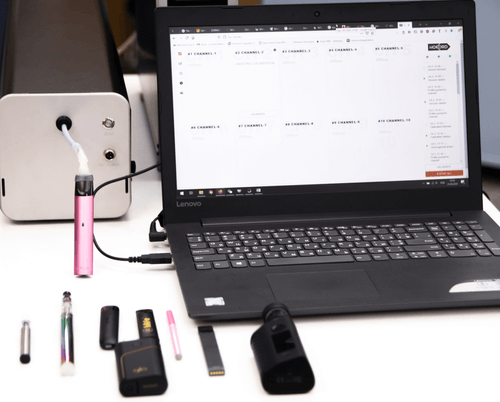
The routine analytical vaping complex HAVC can be operated through any PC, laptop, tablet or even a sensor screen via a WEB Interface. No special software or connection cables are required to operate HAVC, all you need is a Wi-Fi network.
The WEB interface makes the operation of the smoking machine more flexible. It gives the possibility to connect to any devices to operate the parameters and work with data. You can manage all vaping modules, set them up according to test parameters for each device separately. It’s all easy and simple. Additionally, all test reports generated through HAVC’s WEB interface can be customized with your LOGO.
The section is in development. We apologize for any malfunctions
The section is in development. We apologize for any malfunctions
Accessories
There’s a list of additional accessories which may be added to HAVC to expand the functionality of the vaping machine:
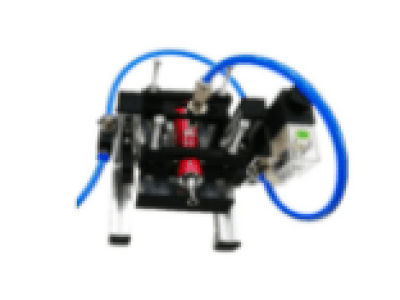
BUTTON PUSHER
With the help of this accessory you can activate the tested device in case it is equipped with a manual activation button
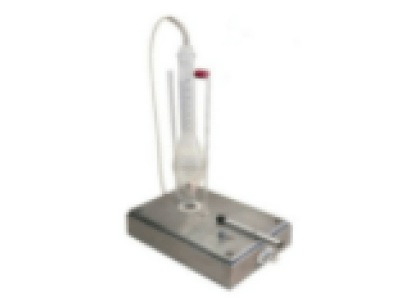
BUBBLE METER
Used for precision calibration prior to ultra-precise sampling
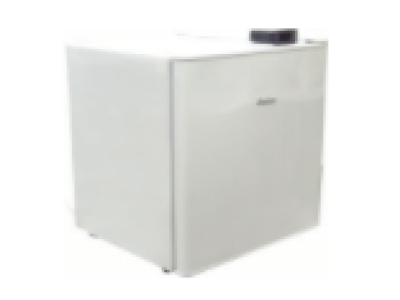
REFRIGERATED CABINET
This testing equipment is designed for testing devices in cold climatic conditions. It allows to study a device`s parameters under low temperatures.
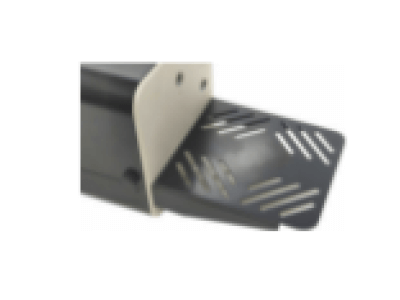
METAL TRAY
Intended for holding the device or additional accessories during testing sessions
Configurations of vaping complex for Laboratories
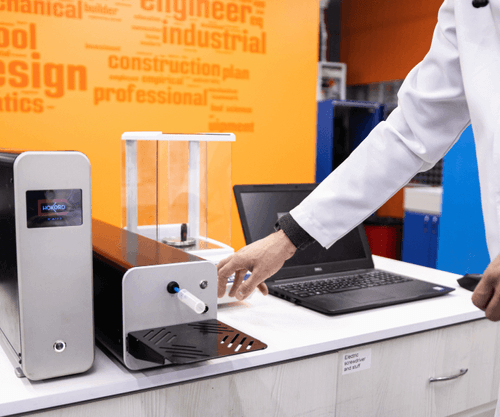
Standard
……………
Full set
……………
MAX SET
……………
Custom
……………
Comparison of the Main Functions
| Types of devices approved for testing on different machines | Gram research (GRAMMUVm) | Borgwaldt (LM5E) | Borgwaldt (NGX10) | Cerulean (SM450E) | Cerulean (CETI 8 range) | HAVC |
|---|---|---|---|---|---|---|
| Vaporizers | X | ✔ | ✔ | X | X | ✔ |
| E-cigarettes | ✔ | ✔ | ✔ | ✔ | X | ✔ |
| Heat-not-Burn systems and consumables | ✔ | X | X | X | X | ✔ |
| HTP | X | ✔ | ✔ | ✔ | ✔ | ✔ |
| Cannabis vaporizers with Cannabis oil | ✔ | X | X | X | X | ✔ |

Upgrade your professional knowledge in the vape testing industry